



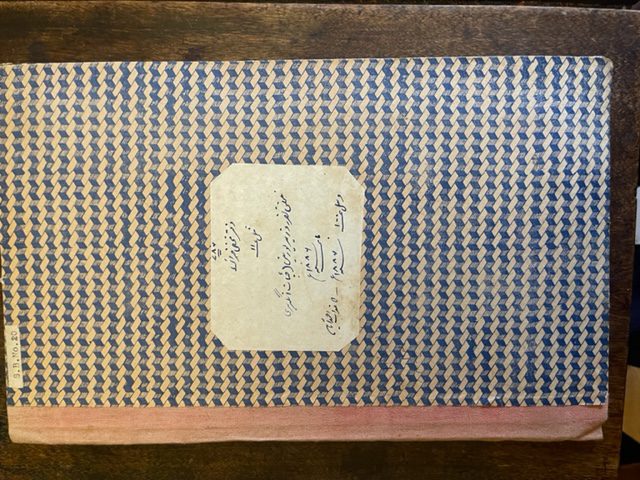
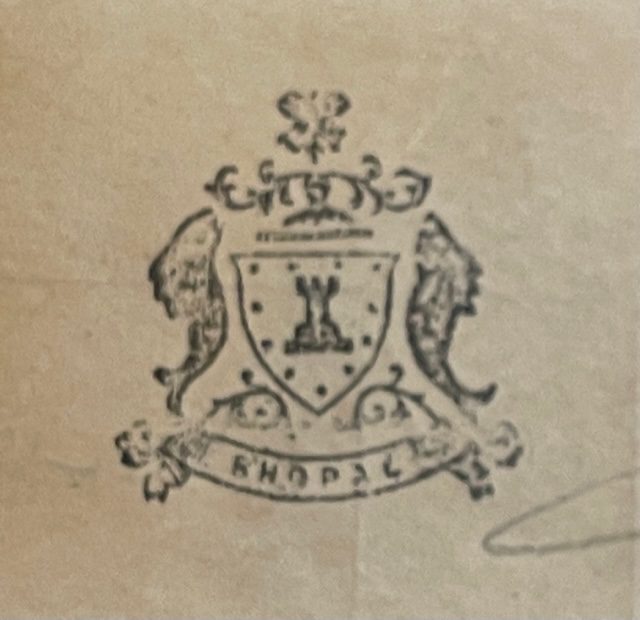
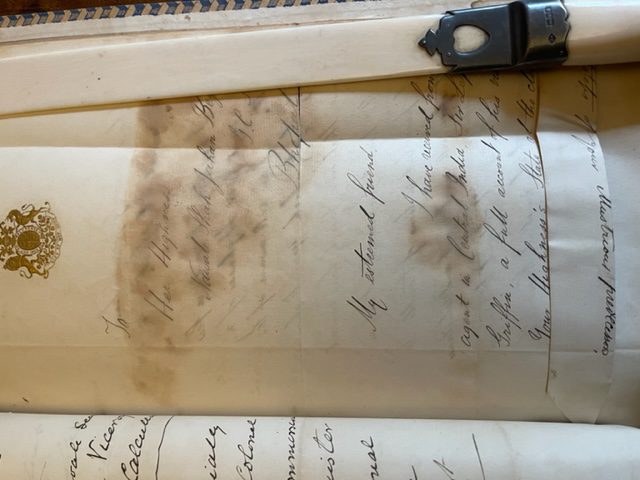
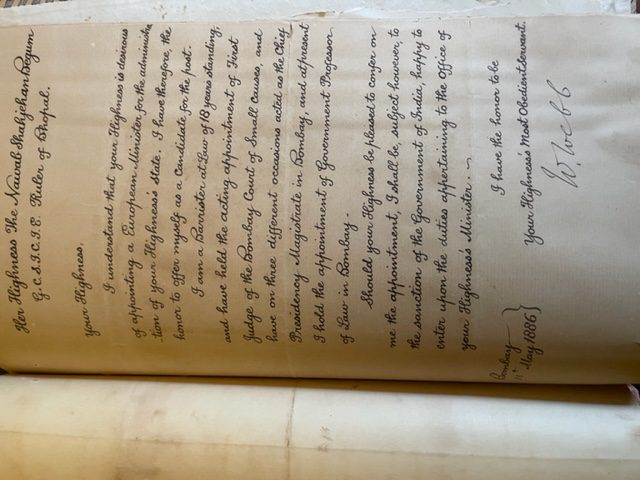
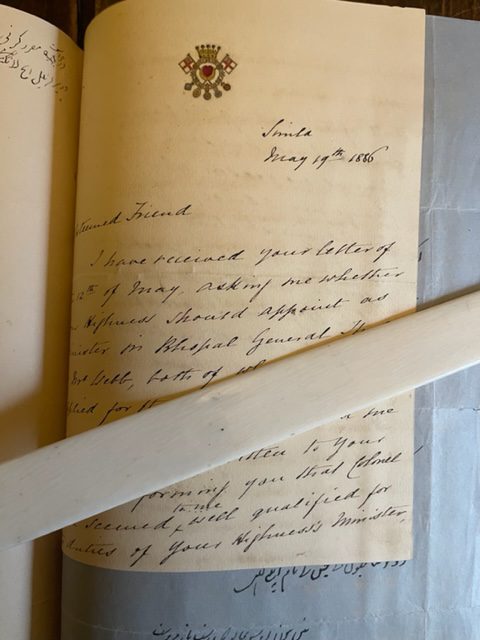
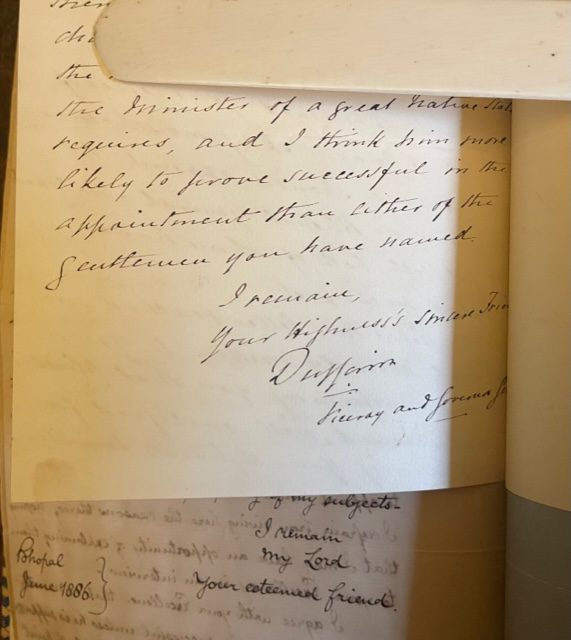
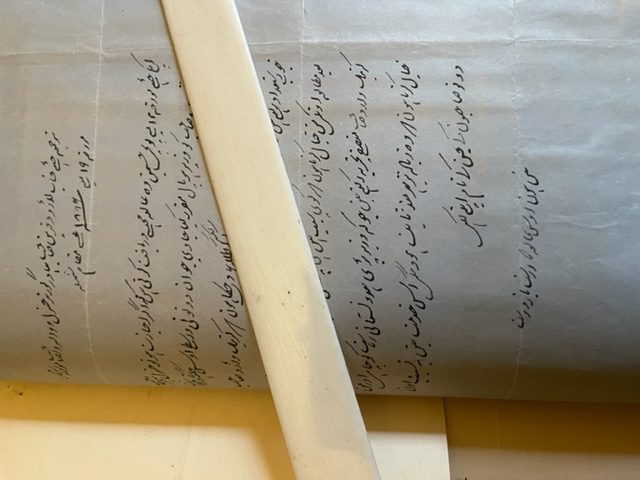
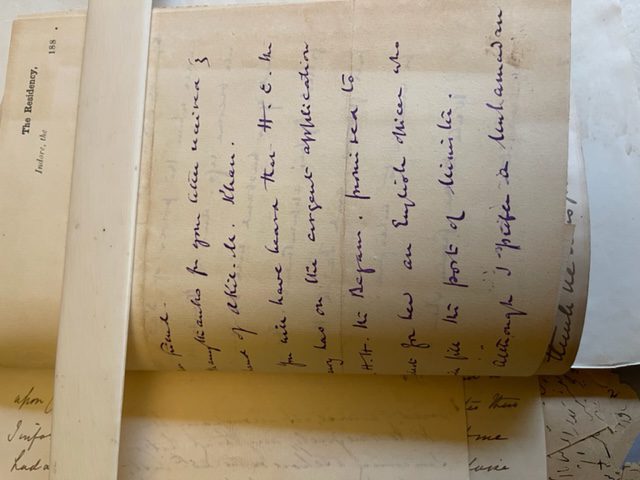
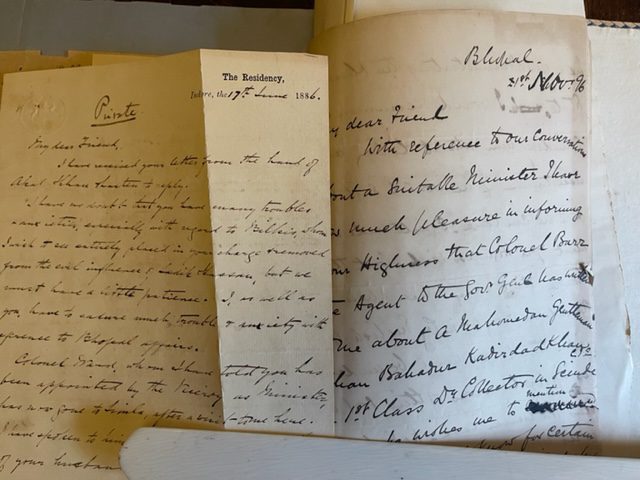
BHOPAL. A highly important folder of original correspdence from Lord Dufferin, Viceroy of India, and his agent to the Begum of Bhopal regading the apointment of a minister.
£2,500.00
The Problem of appointing a First Minister for Bhopal
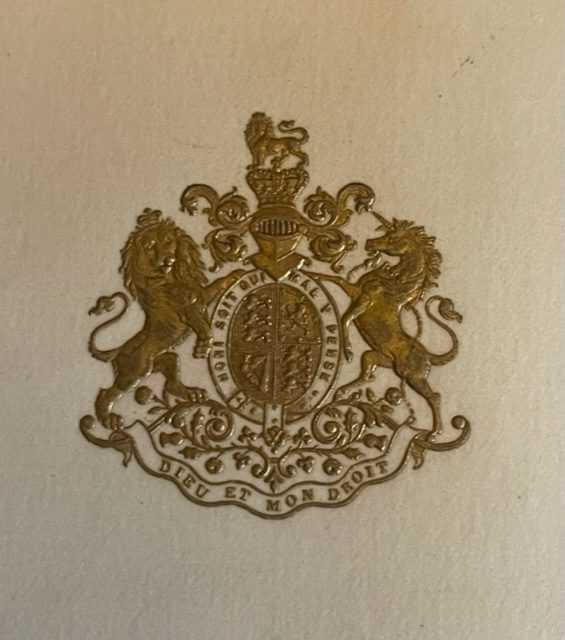
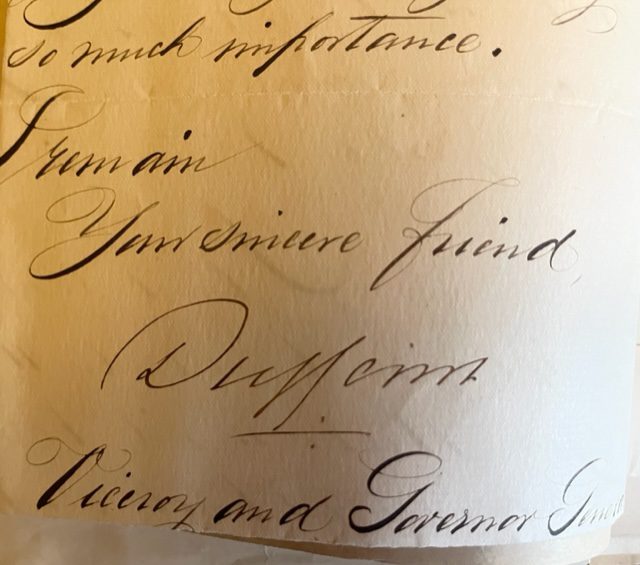
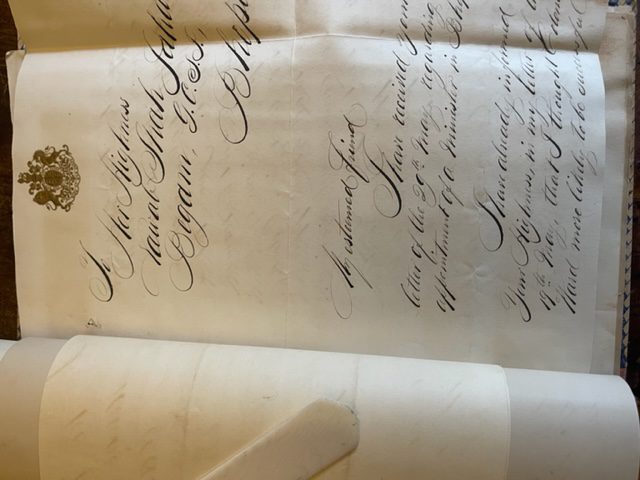
A long letter written in fine palace script over six sides, each bifolium of parchment headed with the Royal Arms of the Viceroy embossed in gold, addressed to Her Highness Nawab Shah Jahan Begam, G.C.S.I., Bhopal and signed Simla The 11th June 1886 Dufferin Viceroy and Governor General of India. A particularly strong and uncompromising letter in which Dufferin begins by reminding the Begum that he thought Colonel Ward had a superior qualification for the post of Minister in Bhopal than either of two candidates she had proposed. In acknowledging her latest letter he concludes that “What your Highness has now written does not alter my opinion.” He corrects the Begum’s criticism of Col Ward’s record and points out “He does not, as Your Highness appears to suppose belong to the Thuggee Department, but to the Civil Commission of the Central Provinces, in which he holds the rank of a Deputy Commissioner of the 1st Class.”
Of her candidates, Major General Thatcher and Mr Webb, Lord Dufferin is dismissive, “I do not know either of these gentlemen but it appears from their applications that Major General Thatcher is a retired officer of the Bombay Army, who was formerly employed in the Police and that Mr Webb is a Barrister who holds the appointment of Government professor of Law. These he considers less worthy then the Mohammedan gentleman he would have preferred [the Begam could not envisage taking instructions from an Indian, it appears] and now urges her to “accept my assurance”. Dufferin makes a great concession [for a Viceroy] of saying that, instead of sending Col Ward directly to Bhopal as “would of course been quite possible” he would summon him to Simla to receive particular instructions from the Viceroy that he was to “show to Your Highness every personal kindness and consideration; that he should make Your Highness feel that the one thing that he has at heart is your own interests and those of your State.” The Viceroy’s concluding sentence has that polite but decidedly firm decision that the matter is closed: “After I have given him his instructions he will go down to Bhopal and present himself to Your Highness and I have no doubt that he will be kindly and cordially received.” In excellent condition, this document is bound by stab sewing in a simple folder with connected documents and letters which led up to the Viceroy’s decision and show some of the events and process which lay behind it. These comprise briefly:
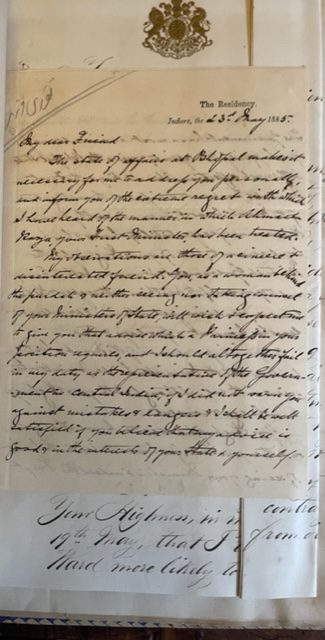
23rd May 1885. A manuscript letter in a neat secretarial hand written on 5 sides of quarto bifolium paper from The Residency, Indore and signed in purple Lepel Griffin [the Agent for the Governor General in Central India]. A typically strongly expressed personal letter informing the Begum of his “extreme regret …of the manner in which Ahmed Raza, your First Minister, has been treated.” He implies that the Begum has been unable to seek proper advice in Bhopal because of her being in purdah and states his duty to offer her advice. He regrets that the minister was dismissed without respect but “been dismissed with insult & ordered to leave his house at a few days notice. The principal reason of the Nawab’s [the Begum’s consort] hostility has been that the Minister had a private interview with me, although with Your Highness’ knowledge and consent.” He continues to say that the Begum had not given her Minister an audience for a long time and he had been pushed aside by the Nawab. He adds, “I rejoice that His Highness the Nizam, who has a more just appreciation of merit, has offered him the Chief Justiceship of Hyderabad on a salary nearly double that which he received in Bhopal & I have recommended that he accept.” He requires that the Begum reforms the administration, appoints a new minister and that “the Nawab-Consort should be forbidden to have any interference with him whatever.” He threatens that unless the Begum behaves as he requires he will ask the Viceroy to appoint a minister himself. Griffin, here and elsewhere, makes it quite clear that it is ultimately the British who make or guarantee important appointments.
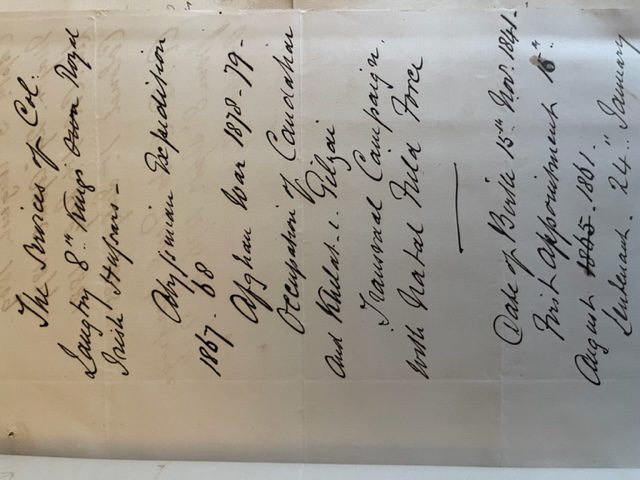
29th May 1885. An original manuscript letter on two sides of a bifolium, addressed to Her Highness the Nawab Shahjihan Begum, G.C.S.I., C.I.E. Ruler of Bhopal written in a secretarial hand and signed Simla H Langtry, Col Comd 8th Hussars. He offers his services as a European Minister for the Bhopal State and describes himself as “a full Colonel in Her Britanic [sic] Majesty’s Army, and at present in Command of the 8th King’s Royal Irish Hussars.” He invites the Begum to consult three rather impressive references: General Sir George Greaves, Commanding the Meerut Division; General The Honourable Sir Arthur Hardinge, The Adjutant General of the Bengal Army; His Royal Highness The Duke of Connaught.” Appended to this is a manuscript record of service in the Colonel’s own hand – Abyssinian Campaign 1867-69, Afghan War 1878-79, Occupation of Khelat i Gilzai, Transvaal Campaign with Natal Field Force, ADC to General Hardinge 1876-78.
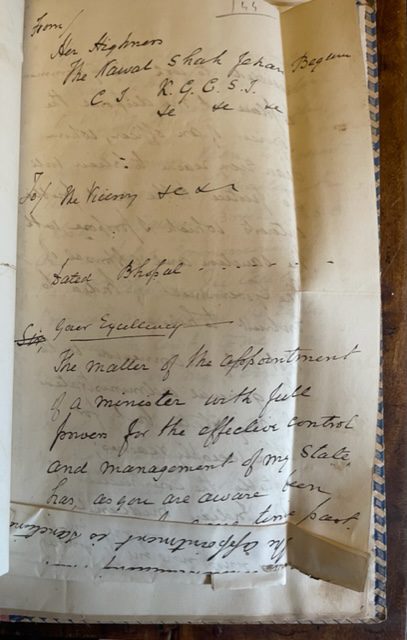
Undated but early 1885. A copy, or perhaps the original dictation for a letter to the Viceroy from Her Highness The Nawab Shah Jehan Begum, C.I., K.G.C.S.I. [sic] etc, etc on five sides of folio writing paper, in which she persists in asking for an English minister giving some of her reasoning, citing “other weighty reasons, notably, the construction of The Indian Midland Railway which, necessarily, will bring a large population of Europeans into Bhopal; the appointment of an English Officer to the post of Minister is in my opinion advisable.” She continues to plead strongly the case of Colonel Brooke and asks he be appointed as a personal favour by the Viceroy.
Undated but early 1885. An undated copy of a telegraphic message sent from HH Nawab Shah Jehan Begum, Bhopal to The Private Secretary to the Viceroy, Calcutta. A single folio sheet “I have today applied officially for the Services of Lieut, Colonel W Saurin Brooke, Deputy Commissioner Central Provinces, as Minister in my State. As Personal favour to myself please comply with my request.” This is strongly worded and that may be the reason it is addressed to the Private Secretary rather than Lord Dufferin himself.
Undated but probably early 1885. A Formal Letter from the Viceroy addressed to Her Highness Shah Jehan Begum, G.C.S.I. written on three sides of paper in an ordinary secretarial hand, each bifolium embossed with the Royal Arms in gold, signed Dufferin. He begins by referring to the mission on which he had sent My Agent General in Central India, Sir Lepel Griffin and his satisfaction with the outcome. He acknowledges the loyalty of Bhopal and his “regret and reluctance that I found myself obliged to sanction a measure which must I know be painful to Your Highness.” The action to which Dufferin refers was the removal of all powers from her consort Siddiq Hassan which had taken place in a Durbar when Griffin had clamped handcuffs on two of his chief henchmen in a dangerous act before the nobles of Bhopal. This letter has some tears without loss and there is a strange browning to some parts – possibly from damp.
19th May 1885. A highly unusual and personal letter from the Viceroy written, possibly in his own hand, on a bifolium of his personal writing paper, embossed with a coloured armorial. The letter is addressed My Esteemed Friend and written from Simla, signed Dufferin. This covers the same ground as the main letter and forewarns the Begum of his decision. He had already written the formal letter when another arrived from the Begum asking whether to appoint General Thatcher or Mr Webb. He states that “after reading the papers which Your Highness has sent me, I think there is no reason why I should change my advice.”.
June 1886. A four page folio fine copy of a letter sent to the Viceroy by the Begum. In this letter she seems, despite repeated references to her loyalty, to have difficulty in retaining her confidence in the Viceroy’s decisions about her new minister. She states “I again take the liberty of informing your Excellency that I am not willing to appoint Colonel Ward as the Minister of my State. I refrain from giving the reasons thereof, hoping that I may have an opportunity of explaining them to your Excellency in an interview.” The Begum now adds that she is very impressed by an application she has received from Colonel H Langtry of the 8th Hussars and she wishes to appoint him instead of Colonel Ward.
17th June 1886. A manuscript letter in a secretarial hand written on two sides of a small quarto bifolium headed with a Govt of India embossed stamp and printed The Residency, Indore, signed Lepel Griffin with Private added in his hand at the head. He expresses the desire to see the “evil influence of Sadik Hassan” [the Begum’s consort] removed and confirms that the Viceroy has appointed Colonel Ward who “will reach you in about a week”. Griffin, the Agent to the Governor General in Central India, adds that he intends to visit Bhopal soon but “the dangerous illness of both Maharajas Sindhia & Holkar [Gwalior & Indore] prevent this.
21st June 1886. A formal letter from the Viceroy on two sides of a parchment bifolium embossed with the Viceregal royal arms in gold, addressed to Her Highness Nawab Shah Jehan Begum, G.C.S.I. and signed Simla The 21st June 1886 Dufferin. The letter, written in fine palace script, acknowledges receipt of her letter enclosing Colonel Langtry’s application. Dufferin is surprised to have received this letter considering how clearly he has previously expressed his opinions and adds “but in case Your Highness should be awaiting an answer I send this letter to inform Your Highness that I see no reason to change my opinion regarding the selection of Colonel Ward. Colonel Langtry, though no doubt a brave and efficient soldier has had no opportunity of gaining the experience in the management of civil affairs to which Your Highness justly attaches so much importance.”
20th November 1885. A small quarto bifolium written on four sides in a secretarial hand, thought to be sent to a Princess of Bhopal, possibly Sultan Jahan, signed in purple Lepel Griffin confirming that he will not allow a Colonel Brooke [the dubious nominee of the Begum’s consort] to become minister of Bhopal
21st November 1885. A small bifolium written on four sides in his own hand by the political Agent at Bhopal and signed W Kincaid addressed to a Princess of Bhopal acknowledging his prior knowledge of the corruption of Siddiq Hassan.
Undated letter, probably January 1886 to the Political Agent, written in a secretarial hand and signed in purple Lepel Griffin concerning interference in the running of the Bhopal state.
Undated letter on a small quarto bifolium of writing paper headed with a Govt of India embossed stamp and printed The Residency, Indore, written in his own hand in purple ink and signed Your sincere friend Lepel Griffin, noting that the Viceroy has, at the Begum’s urgent request, decided to find her a British officer to serve as principal minister of her state. He remarks that he would have preferred “a Mahomedan minister for many reasons.” In an interesting apparently personal note he adds that he includes a brooch of a gold fish with a diamond eye which he had promised to Shah Jehan’s granddaughter Bilquis Jahan. This first born grandchild had been adopted as her heir by the Begum and lived with her while the daughter and her other grandchildren languished in isolation from the court.
10th May 1885. Two manuscript copies of letters from W Webb addressed to the Begum from Bombay putting himself forward as a candidate to become European minister of her state.
There are also a few Persian copies and letters included in this folder. nov16/1
Significance: Bhopal was a very senior princely state with a 19 gun salute, the second senior muslim state [after Hyderabad] and the only state to be ruled over by a female ruler for most of the nineteenth century. Only very senior rulers were addressed direcctly by the Viceroy so any letters on his characteristic writing paper are scarce. Diplomatic language was always very polite, so it is extremely unusual to see such strong expressions of will contradicitng the ruler’s wishes.
1 in stock
Related products
-
Royal Scots Fusiliers. Embossed regimental badge in black
£4.00 Add to cart -
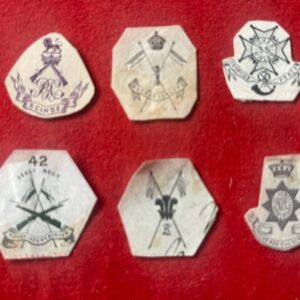
Military crests of Indian Regiments, £5 each
£5.00 Add to cart -
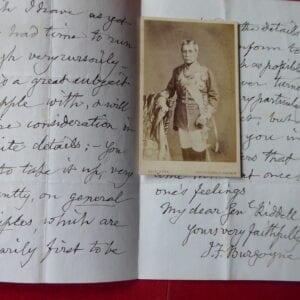
Field Marshal Sir John Fox Burgoyne, G.C.B., cdv and signed letter 1868 to Gen Riddell, both engineers.
£175.00 Add to cart -
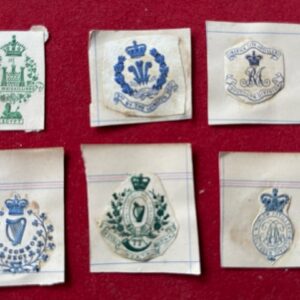
Irish Regimental embossed crests cut from stationery, etc
£4.00 Add to cart